
The Nuclear Option: How to Write a Paper the Night Before It’s Due

by Sam Berman-Cooper

We’ve all been in this situation. 7pm. Paper due tomorrow at noon. No draft. No outline. No time machine. What do you do, what do you do?

Have no fear! Here are a few Quick Tips you can follow to avert disaster.

1. Ask yourself: Have I done the reading? If your answer is “no” go on to step 2. If you answer is “yes,” ask yourself “what are 4 or 5 interesting facts about the reading? If you cannot produce said facts, you answered incorrectly. You may have “done” the reading, but in practice, you may as well have not. Go on to step 2. If you are confident in your mastery of the necessary reading, ask yourself “do I have a good idea to write about?” If your answer is “no,” go to step 3. If your answer is “yes,” go on to step 4.

2. Accept the fact that you are not going to hand in your paper on time. Accept that this is not the end of the world. Email your TF (or whoever is grading your paper) and tell him/her that your paper will be late and you have no valid excuse. Without notification, he/she will be confused as to where your paper is, and probably more irritated than if you had been upfront about it. Go on to step 3.

3. Go over your readings with a pen or a highlighter. Figuring out an idea to write about should be your first priority as you read. Take your time and think carefully about the authors’ arguments. There is no such thing as a good paper without a good idea. Once you’ve decided what you want to argue, go on to step 4.

4. To quote the immortal Douglas Adams: Don’t Panic. You’ve done the readings and you have an idea. It may be that you can still get a good grade. Even if you can’t, just think how many assignments you are going to do here in four years. One average grade won’t kill you (or your chances of making mad bank).

5. DO NOT plagiarize. Let me repeat that. DO NOT even consider plagiarizing. You will get caught. You will get Ad-Boarded. It will go on your record. You will regret it.

6. Figure out exactly how much time you have between NOW and the time your paper is due. Do not try to work straight through. You will get less and less efficient (and worse and worse at writing) if you refuse to take breaks.

7. Figure out what kind of essay you are writing (lens essay, research paper, etc.) and Check THE WRITING CENTER BLOG for templates. For example, check out Emily’s post for tips on how to write a good lens essay.

8. Quickly create a schedule to accommodate your personal writing process. I like to make very detailed outlines and spend less time drafting and revising. If I have 12 hours to do a close-reading paper (critical analysis of one source or one author), my schedule might look like this:

a. Midnight-1:00am: Use a Writing Center Blog Post to help create a very loose outline – just a vague thesis, ideas for topic sentences, 3- 5 body paragraphs, and possibly a conclusion.

b. 1:00-2:30am: Close-read/re-read relevant parts of the text to find quotes/evidence and flesh out each body paragraph. Add each quote (with its page number/source) to the outline.

c. 2:30-3:00am: Take a break. Get some food, maybe do some jumping jacks. In the short term, 15-20 minutes of exercise is proven to be more effective for waking you up than a 15-20 minute powernap.

d. 3:00-3:45am: Write a thesis statement and introduction. This is the most important part of your essay, so take your time.

e. 3:45-7:00am: SLEEP!!! I cannot stress this part enough. You will have a much clearer mind and work much better and much faster if you get some sleep cycles in.

Check out this page on typical sleep cycles to help you plan your nap. Deep Sleep and REM sleep are particularly important for processing information and feeling alert and energetic when you wake up. If you set your alarm to go off during DEEP SLEEP (stages 3+4) you will probably feel groggy (and not much better at writing) when you wake up. Try to get a least one full cycle (3 hours) and time your naps to not wake up during periods of Deep Sleep.

f. 7:00-7:30am: Shower/eat. Showering will help you wake up, plus it will give you time to think about what you want to say. Don’t go without food. Your mind is a machine, and it needs fuel!

g. 7:30-10:00am: Write your body paragraphs. Follow your outline as closely as possible. This is GO TIME, when the heart of your essay comes to life. You should feel a little pressure at this point, but that’s a good thing – it will make you work faster. As long as your outline includes all the evidence you need, the real work is done. Now you’re just translating bullet points into sentences.

h. 10:00-10:15am: Another break. Stop thinking for a little while. You will feel better.

i. 10:15-11:00am: Write a conclusion and start re-reading/revising. Keep your eyes out for sentences that seem unclear, points that need a little more evidence, spelling and grammar; any problem that can be solved with a quick fix.

j. 11:00-Noon: Final revision. Double-check all your sources and look for carelessly placed words and grammatical errors. Save, print, staple. You have successfully completed an essay in 12 hours. After class, pass out for as long as possible!
Structure: Four Warning Signs

by James Fuller

A good structure is often a clear sign of a good argument.  On the flip-side, a weak structure is often one of the most obvious signs of a weak argument.  If one or more of the following is true of your structure, you may want to reconsider the thesis, examples, or logical progression of your paper.

These aren’t hard and fast rules.  You may find that one of the following is true of your structure, but your discipline or some special feature of your argument makes it OK.  However, if your paper bears one of these signs, you have a good reason to take a long, critical look at it.

This semester, I took English 192 with Elaine Scarry.  Before setting us loose to write our final paper, Professor Scarry gave us two pieces of advice.  The first two warning signs are an expansion on that advice.  The second two warning signs I draw from my own experience as a writing tutor.

WARNING SIGNS

1. The structure of your paper exactly follows the structure of the text you are writing about.  For example, if you are writing about Moby-Dick, you might notice that each paragraph addresses a subsequent chapter.  This is a worrisome sign.  It may mean that you are allowing Moby-Dick’s narrative to determine the structure of your paper.

This may seem like a reasonable way to structure your paper, but your structure should be determined by the logical progression of your argument, not the order of the text you are writing on.  When you start a new paragraph, you should ask yourself, “What would develop develop my argument and prove my point?” not “What comes next in the plot?”

If you are worried that readers won’t be able to follow your argument if they don’t know the entire plot of Moby-Dick, then your argument may be too broad.  In most text based essays, you should focus on local, specific observations that can be situated with a small amount of narrative context.

2. You address multiple texts, and each text has its own discrete section of the essay.  For example, the first half of your paper addresses Mill’s On Liberty, and the second half of your paper addresses Hobbes’ Leviathan.

Again, this may seem like a reasonable structure.  However, in most essays that ask you to address multiple texts, you will want to bring these texts into dialog rather than treating each separately. Instead of having one section on one thinker and one on another, try organizing your paper around the points you want to make about both texts.

In the end of the day, you may find that your thesis is best served by giving each text its own section.  However, you must be certain that you have a single argument that brings the texts into relation with one another.  The “first A then B” structure should be a deliberate argumentative choice, not the default.

3. Your paper has unexplained transitions.  Common examples include “Before addressing W, I must address X,” “This leads me to Y,” and “I will now address Z.”  The problem with these transitions is that they proclaim a logical order without explaining it.  Why do you need to address X before W?  How does the previous paragraph lead you to Y?  Why are you addressing Z at this point in your essay?  The answers to these questions may be clear to you, but they may not be clear to your audience.

You should aim for substantive transitions that explain the relationship between what you have been discussing and what you are going to discuss.  Substantive transitions will help you make a cohesive argument because they will force you to reflect on why you are addressing certain points in a certain order.  If your essay has many unexplained transitions, you may need to reconsider the overall structure of your argument.

4. Your body paragraphs could occur in any order.  In other words, there is no good reason that you address one thing before another.  If this is true of your essay, you may be listing examples rather than making a sustained argument.

Even if your paper involves multiple examples of the same phenomenon, each example should bring out new aspects of the phenomenon or nuance your position.  If an example does neither of these things, you may want to delete it.

The Four Parts of a Lens Essay Argument

by Emily Hogin

One of the most common prompts I see at the Writing Center is the “lens essay.” A lens essay brings two texts in dialogue with one another in a very particular way. It asks you to use Text B – the lens – to illuminate something you didn’t already know about Text A.

How Not to Argue a Lens Essay

A lens essay is not a list of differences and similarities between two texts. The following are some (exaggerated) examples of a bad argument for a lens essay I’ve come across at the Writing Center:

Even though one is philosophy and the other is a novel, both Text A and Text B talk about the imagination.

This first thesis statement notes a similarity between the two texts that will likely be obvious to readers of the text. It doesn’t use one text to illuminate anything about the other.

While both Text A and Text B argue that human nature is unchangeable, Text A asserts that humans are inherently good and Text B asserts that humans are inherently bad.

This thesis makes a claim about each text but doesn’t say anything about them in relation to each other.

Text A, a poem, does a better job of communicating the emotional struggles of living with HIV than Text B, a statistical report, because a poem allows readers to identify emotionally with other people while statistics are more abstract and cold.

This third thesis statement does make an argument that connects both texts, but again fails to use one text to tell us something we don’t already know about the other text.

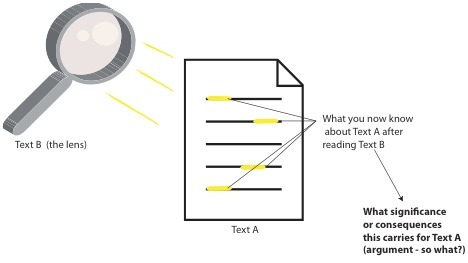
Here is an illustration of what an effective lens essay will look like:

In my experience, a successful lens essay implies a certain kind of thought-process that has at least four parts:

(1) I read Text A

(2) I read Text B (my lens)

(3) I re-read Text A and noticed something I didn’t notice before

(4) That something turns out to carry consequences for my overall reading of Text A (thesis/argument)

(And if you really want to wow your reader, you’d add a final part:)

(5) Applying Text B (my lens) in this way also reveals something significant about Text B

When I say significance or consequences, I don’t mean that it has to alter the meaning of a text radically; it can be something small but important. For example, you might find that one element is a lot more important (or a lot less important) to the overall text than you had previously thought.

As an example, here is an excerpt from the introduction to my last lens essay:

The concept of the imagination is ambiguous throughout Venus in Furs: at times, the imagination appears as passive as a battleground that external forces fight to occupy and control; at other times, the imagination appears to drive the action as if it is another character. Any theory of sexuality that seeks to explain Venus in Furs thus must be able to explain the ambiguity over the imagination. Foucault’s theory of the inescapable knowledge-power of sexuality comes close to being able to explain Sacher-Masoch’s ambiguous concept of the imagination, but applying Foucault in this way highlights Foucault’s own difficulty situating the imagination within his theory.

You can see my lens essay thought-process in just these three sentences:

(1) I read Venus in Furs (Text A) and noticed that the imagination is ambiguous

(2) I read Foucault (Text B, my lens) (3) to better understand the imagination in Venus in Furs

(4) Foucault helped explain why an ambiguous imagination is an appropriate way to look at sexuality

but (5) applying Foucault to the imagination tells me that Foucault’s own theory is challenged when he has to account for the imagination.

Once you have an argument for a lens essay, you will have to structure your paper in a way that allows this lens essay thought-process to come across. This means that each of your topic sentences should refer back to this thought-process. Even if you need a paragraph that discusses one of the texts primarily, your topic sentence should justify why you’re doing that. Your complicated and interesting thesis will likely require you to move back and forth between Text A and Text B (your lens).

Of course, your argument will depend on your assignment, but I’ve found this four-part approach successful in a number of courses where the assignment asked me to bring two texts in dialogue with one another.